

Home / Methodology
FECS · The family enterprise continuity system
A system, not improvisation
We help owners build a company that works without daily reliance on the founder and can safely pass to the next generation. The goal is not corporatisation — the goal is continuity across generations.
Three principles of the FECS methodology
Principle 1
Diagnosis before solution
We don't propose solutions until we understand both the company and the family. Every engagement begins with an assessment of the situation, not with a packaged offer.
Principle 2
Business and family together
The technical and emotional sides aren't separated. A board without a family agreement doesn't last, and a family constitution without a professional company stays on paper.
Principle 3
Knowledge transfer, not dependence
The goal isn't for you to call us forever, but for your company and family to take control of their own system.
Four dimensions
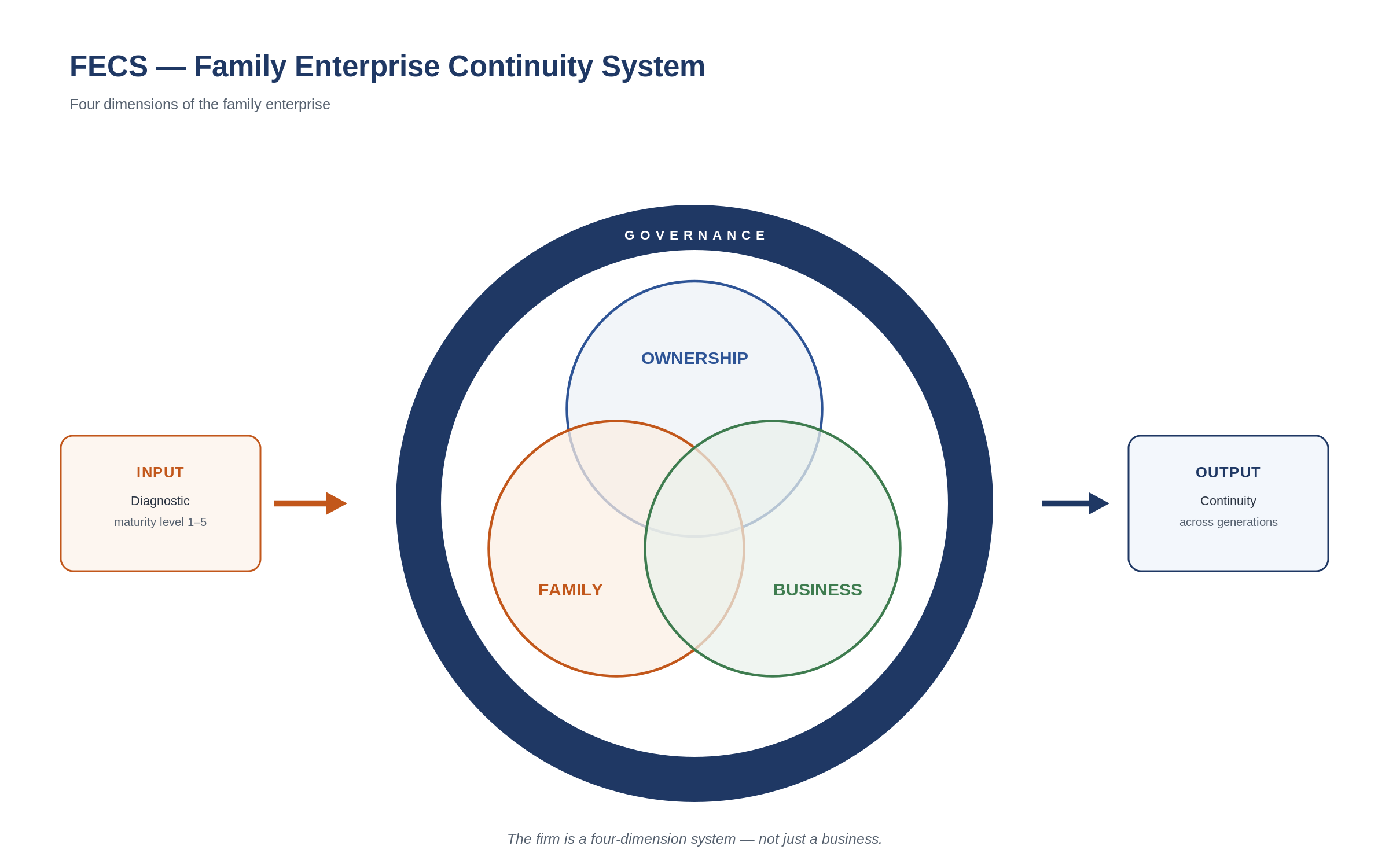
A company is a system of four dimensions, not just a business
FECS views a family business through four dimensions that constantly intersect. A healthy system keeps all four in balance.
Family
The values, relationships and rules that hold the family together.
Ownership
Who owns, who carries the risk, and how profit and influence are shared.
Business
The company's strategy, organisation and results.
Decision-making & oversight
Who decides what, and who holds whom accountable.
Eight pillars
The eight pillars of the continuity system
The content of the FECS methodology — eight areas that together form the continuity system of a family business.
01 · Diagnostic
An assessment of the situation: maturity score, sub-scores and blocking risks.
02 · Strategy
The direction of the company and the owner, aligned in the same direction.
03 · Professionalisation
Organisation, processes, KPIs and delegation of decisions.
04 · Corporate governance
Board, decision rights and a reporting rhythm.
05 · Family governance
Family council and constitution — the family's rules towards the firm.
06 · Succession
Transfer of leadership and control to the next generation.
07 · Ownership
Ownership strategy, dividends and transfer of shares.
08 · Implementation
Carrying out and embedding the system into everyday work.
The logic of the sequence
Why the sequence, and why it changes
Most family businesses try to introduce a board before they have a strategy, or to plan succession before they have professionalised the business. That's why the work has an order — each phase creates the conditions for the next. But if a blocking risk exists (B1–B5: dependence on the founder, conflict, an ownership vacuum, acute succession or low capacity), the order changes and that risk is resolved first.
The goal is not corporatisation. The goal is continuity.
Cooperation path
What working together looks like, step by step
The methodology sits within a wider flow of work — from the first assessment to ongoing oversight. Each step leads into the next.
FECS Quick Assessment
One working day on site. A maturity score, risks and the order of priorities — the basis for a decision.
Learn more →Academy or preparation
Knowledge transfer and guided system-building (A2T) — from strategy to an implementation plan.
Transformation
Deep implementation of the continuity system through the eight phases of the methodology.
Quarterly review
Continuity Review: quarterly oversight of the board, KPIs and risks, with an annual re-diagnosis.
Eight phases
From diagnostic to continuity
Entry: diagnostic and maturity level 1–5. Exit: continuity across generations. Typical duration: 12–24 months.
Preparation
We set the engagement framework, a dependency map and, if needed, an emergency succession plan. The client's obligations and the initial score are defined.
Diagnostic
Maturity score 1–5, sub-scores by dimension and blocking risks B1–B5. The result is a clear report with priorities — the foundation for everything that follows.
Strategic direction
The company's strategy aligned with ownership goals: markets, priorities, dividends and reinvestment.
FrameworkPESTEL • SWOT/TOWS • Ownership strategy
Professional system
Organisation, RACI/DOA, KPIs, reporting and delegation of decisions. The company stops depending on one person.
FrameworkGalbraith Star • Lean & Kaizen • KPI/OKR
Decision-making & oversight
A board or advisory board, decision rights and family governance (council, constitution). The owner moves from operations to governing.
FrameworkBoard Governance • Family council
Succession
A succession plan, successor development and the transfer of control and ownership, confirmed by a family constitution.
FrameworkFamily Governance & Succession
Implementation
Carrying the work out on the ground and embedding the system into everyday work — up to the test that the company runs without the founder day to day.
Monitoring
Continuity Review: quarterly oversight of the board, KPIs and risks, with an annual re-diagnosis and a comparative score.
Result
What you have at the end of the process
Continuity across generations
A clear strategy
A defined organisation
Measurable goals
Professional governance
Developed successors
A succession plan
Less dependence on the founder
Proven in practice
Companies that have applied our methodology






The first step is a short conversation.
In 15 minutes we check where you stand today and whether a Quick Assessment now makes sense — and what the first step is.
No obligation.